

Features
Why Choose KinKuo?
10-Year R&D Excellence
Founded in 2010, Kinkuo has a decade-long track record of innovative connector and cable design for industrial automation and high-end applications.
Wide-Ranging Expertise
Core portfolio spans double-shielded signal cables, 10-million-cycle drag-chain cables, industrial camera & network harnesses, oil-resistant assemblies, and complete SCSI/VHDCI/D-SUB/USB 3.0 connector lines.
Global Brand Trust
Long-term preferred supplier to renowned customers across Japan, Taiwan, Europe, the Americas, and Mainland China, attesting to consistent quality and reliability.
Tier-1 Supply Chain Access
Authorized distributor of Amphenol’s latest high-speed interconnect portfolio (SFP, QSFP-DD, OSFP, SlimSAS, Gen-Z, etc.), enabling turnkey, future-proof solutions.
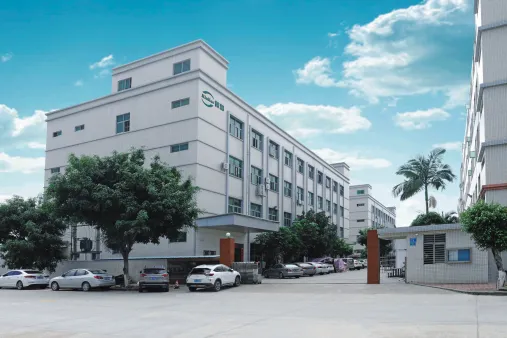
We Have The Best Solutions for Your Business
1. Cable Ass'y products: double shielded signal control Cables (SCSI, VHDCI, D-SUB, USB, LFH, SDR), Ten million times drag chain line, industrial camera wiring harness, industrial network cable, mechanical equipment oil resistant wiring harness, customized various specifications Cable research and development, assembly.
2. Connector products: SCSI, VHDCI, D-SUB, LFH, USB 3.0, servo motor peripheral series connectors.
3. Brand agent: Amphenol (SFP, SFP28, QSFP, QSFP28, QSFP-DD, OSFP, CFP2, CFP4, MiniSAS HD, SlimSAS, PCIeSAS, Oculink, MCIO, Gen-Z)
Attentive service, perfect quality!
In my 15 years in high-speed connectivity, I have seen technologies rise and fall, but few have had the revolutionary and lasting impact of the QSFP connector. It is, without exaggeration, the component that built the modern cloud. Before its arrival, scaling a data center was a constant battle against physics—ports were too big, consumed too much power, and you could only fit so many on a switch. The QSFP changed the entire game. Since we began our work in 2010, we've had a front-row seat to this revolution, supplying the critical connectors that became the workhorse of the data center.
The genius of the first widely adopted version, the QSFP+, was its brilliant efficiency. It took four 10-gigabit lanes—the standard of the day—and bundled them into a single, compact, pluggable interface. Suddenly, a 40G port was no bigger than two of the older 10G ports. This breakthrough in density was the spark that ignited the hyperscale data center explosion. It allowed engineers to design 1U "pizza box" switches with an unheard-of 32 or 48 high-speed ports, enabling the massive, flat network fabrics that cloud computing relies on. The QSFP connector wasn't just an improvement; it was an architectural enabler.
Then, as the demand for bandwidth continued its relentless march, the platform evolved. The arrival of the QSFP28 was another stroke of engineering brilliance. It kept the exact same physical form factor that everyone knew and trusted, but re-engineered the internal connector to handle much faster 25G signals per lane. This gave us a 100G port in the same physical space as an old 40G port. This backward compatibility was a massive gift to the industry, allowing for smooth, gradual upgrades without a disruptive "rip and replace" of the entire infrastructure. It cemented the legacy of the QSFP connector as not just powerful, but also practical and intelligent.
As an agent for a leader like Amphenol, who has been instrumental in perfecting this technology, it's been a privilege to be part of this story. We understand that every QSFP connector we supply is a critical node in our customer's network. It's a component that demands perfection in its materials, precision in its manufacturing, and an unwavering commitment to quality—a commitment we are proud to deliver every single day.
Featured Products
Collection about KinKuo
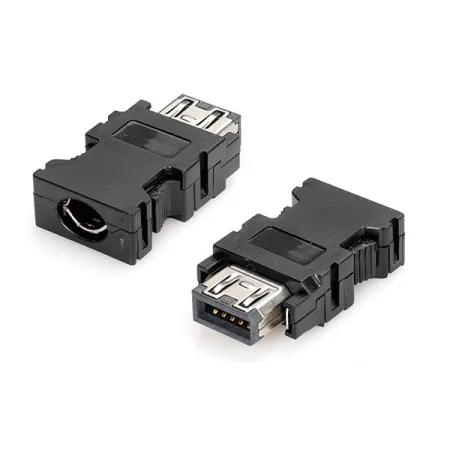
KinKuo Servo Connector – Mini D Ribbon MDR 1.27 mm Pitch
KinKuo Servo Connector MDR series offers 14–100 contacts, 500V, RoHS2.0 compliance—perfect for Servo Connector cable assemblies.
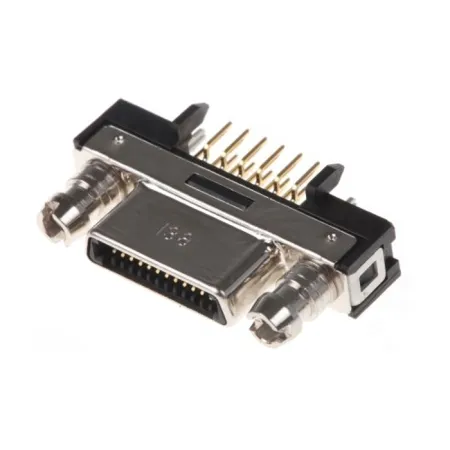
KinKuo VHDCI Connector SDR 0.8 mm 26-pin High-Speed Solution
KinKuo VHDCI Connector SDR offers 0.8 mm pitch, 26 contacts, 350 V isolation—ideal for VHDCI Connector cable assemblies in tight spaces.

KinKuo SCSI Connector MDR 1.27 mm 14-100 Pin High-Density
KinKuo SCSI Connector MDR series delivers 1 A, 500 V, 500 MΩ, –55 °C~+105 °C—perfect SCSI Connector for high-density cable assemblies.
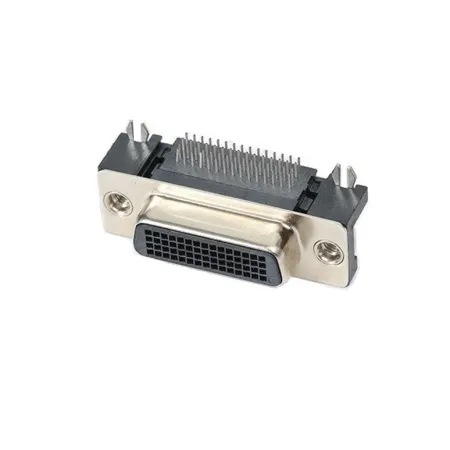
KinKuo LFH Connector 1.27 mm 59–200 Pin Low-Force Helix
KinKuo LFH Connector delivers 1 A, 500 V, <10 mΩ, low 60 g mating force—ideal LFH Connector for medical & industrial boards.
User Reviews
What users say about KinKuo
Frequently Asked Question
Do you have any question?
Using a genuine Amphenol QSFP connector is critical because Amphenol is a world leader who has perfected the signal integrity and mechanical reliability of the design. A counterfeit connector will not meet the tight tolerances required for 100G signals, leading to high data error rates and network instability. Sourcing from an authorized agent like KinKuo guarantees you get an authentic, high-performance part.
Yes, in most cases. A QSFP28 port on a switch is generally backward compatible with a QSFP+ module or cable. When you plug a 40G QSFP+ transceiver into a 100G QSFP28 port, the port will typically auto-negotiate and operate at the lower 40G speed. This backward compatibility is a major advantage for phased network upgrades.
The QSFP connector became the industry workhorse because it offered the perfect balance of density, power, and performance. Its compact size allowed switch manufacturers to put a large number of 40G and 100G ports on a single 1U faceplate, enabling the massive scale-out architectures that modern cloud data centers require.
The cage assembly is the metal housing that is mounted to the host device's circuit board. A QSFP connector cage serves three critical functions: it provides a secure mechanical guide and latch for the pluggable module, its metal construction and EMI gaskets contain electromagnetic interference, and it helps dissipate heat from the transceiver into the chassis.
While they share the same physical form factor, the key difference is speed. The QSFP+ connector is designed for 40G applications (4 lanes x 10 Gbps). The QSFP28 connector is the next generation, engineered for 100G applications (4 lanes x 25 Gbps). The "28" refers to the maximum signal speed per lane of approximately 28 Gbps to account for encoding overhead.
QSFP stands for Quad Small Form-factor Pluggable. A QSFP connector is a high-density, 4-channel I/O interface used in networking equipment like switches and routers to connect them to fiber optic or copper cables. It is "hot-pluggable," meaning you can insert or remove a transceiver or cable without shutting down the system.
Our updates and blog posts

Servo Connector Mastery: How KinKuo’s Servo Connector Range Eliminates Downtime and Future-Proofs Motion Systems
Explore KinKuo Servo Connector solutions—IP67, 10 M flex, same-day ship. Cut downtime and future-proof motion systems today.
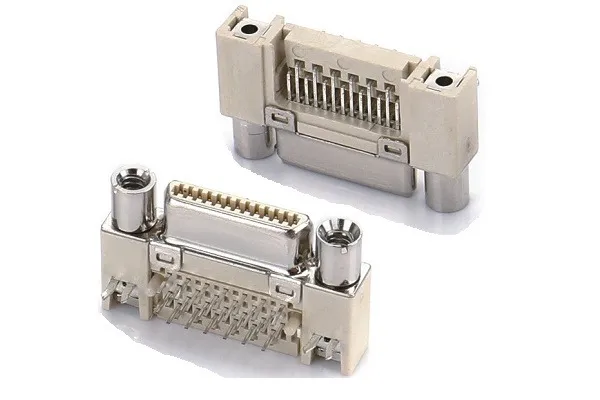
VHDCI Connector Deep Dive: How KinKuo’s VHDCI Connector Range Delivers 68-Pin Density with Zero Signal Loss
Explore KinKuo VHDCI Connector solutions—0.8 mm pitch, 500 V, RoHS. Cut space and boost speed with proven VHDCI Connector today.
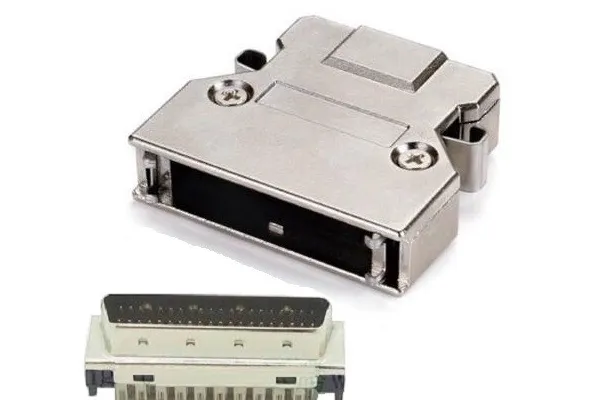
SCSl Connector Deep-Dive: How KinKuo’s SCSl Connector Portfolio Delivers 68-Pin Density with Industrial-Grade Reliability
Explore KinKuo VHDCI Connector solutions—0.8 mm pitch, 500 V, RoHS. Cut space and boost speed with proven VHDCI Connector today.